

TL;DR: Coworking’s stereotype is a freelancer with a laptop, but the reality is much broader, small tech teams, law practices, sales teams for out of town companies, consultants, back office staff and founders who started at one desk and now run teams of ten or more. The post argues coworking’s real edge is speed and flexibility, moving in within days instead of months, and adding or releasing seats without renegotiating a lease, and closes with a bit of honest advice: the best workspace decisions come from people who admit they don’t know their headcount eighteen months out and buy optionality instead of pretending otherwise.
I have signed the paperwork on both sides of this transaction. Before I started Hub and Oak, I sat in meetings as a tenant, listening to a landlord explain why a nine year lease with a three year lock-in was “standard” for a fourteen person team that had no idea whether it would be fourteen or forty by the following March. Today I run coworking centres in Delhi NCR, and I watch people walk into our Defence Colony and Okhla spaces with the same question I had back then, phrased slightly differently every time.
The question is never really “which space is cheapest”. It is closer to “how do I choose without regretting it in four months”.
That is the question this guide answers.
A quick note on why the answer has changed. For most of the last two decades, choosing an office in India meant choosing a building, then spending three to five months and a large amount of capital turning that building into a workplace. Furniture, electricals, air conditioning, a fire NOC, an internet connection that took six weeks to provision, a receptionist, a housekeeping contract. Then hybrid working arrived, headcounts stopped being predictable, and a lot of founders discovered that a five year commitment on a fixed floor plate is an expensive way to be wrong about the future.
Coworking absorbed that uncertainty. It is not a fashion. It is a response to a real change in how work is planned.
But the abundance of options has created a second problem. Search “coworking space near me” in Delhi and you will get directory listings, sponsored results, and about forty spaces that all photograph identically: exposed brick, a neon sign, plants on a shelf. The photographs tell you almost nothing about whether the internet holds up at 4pm on a Wednesday, or whether the meeting room next to your cabin is soundproofed, or what happens to your deposit if you leave in month seven of a twelve month agreement.
So this guide is built around the things that actually determine whether a workspace works. Some of it is standard evaluation criteria. A fair amount of it is specific to India and to Delhi NCR in particular, because GST, security deposit norms, building compliance and metro connectivity are not footnotes here. They are the deal.
Before we get to how to find a coworking space, it is worth being precise about what the word actually covers, because the industry uses it very loosely.
What Is Coworking?
Coworking is a workspace model where professionals and companies from different organisations share a single, fully serviced office, paying a monthly membership instead of signing a property lease. The operator owns or leases the property, fits it out, staffs it, maintains it, and sells access to it in units as small as one desk.
That is the whole idea. Everything else is detail.
The word arrived in its modern sense in 2005, when a software engineer named Brad Neuberg set up a small shared space in San Francisco for people who wanted the structure of an office without the employment relationship that usually comes with one. India’s first serious wave came much later, roughly 2015 onward, driven by the startup funding cycle. The second and much larger wave came after 2021, and this one was driven by enterprises rather than startups. That distinction matters more than people realise, and I will come back to it.
How coworking actually works
You pay a monthly fee per seat. In exchange you get a desk or a cabin, a chair, power, air conditioning, internet, housekeeping, security, a front desk, tea and coffee, and some allocation of meeting room time. There is usually a security deposit, typically one to three months, and a commitment period that can run from one month to three years depending on how much space you take.
You do not pay separately for a furniture vendor, an electrician, an air conditioning AMC, a housekeeping agency, a security agency, or the interest on the capital you would have sunk into a fit-out. The operator has already spent that money and spread it across every member in the building. That is the arbitrage, and it is real.
Who uses coworking spaces
The stereotype is a freelancer with a laptop and a flat white. The reality in our centres looks different. On any given weekday at our Okhla centre you will find a mix that includes small technology teams, litigation and corporate law practices, sales teams for companies headquartered in another city, consultants, back office teams for larger firms, and at least a few solo founders who joined at one desk and are now at eleven.
Hub and Oak has provided managed and flexible workspace to organisations including Housing.com, Mercedes through Global Star, Leverage Edu, Unstop, Hunch and Traq Check. None of those are two person startups. The enterprise shift is the single biggest change in this industry in the last five years.
The benefits, stated honestly
Coworking gives you speed, because you can move in within days rather than months. It gives you flexibility, because you can add or release seats without renegotiating a lease. It converts a capital expense into an operating expense, which matters enormously if you are pre-revenue or if your board watches cash burn. It removes facility management from your to-do list. And it puts you in a building full of other businesses, which produces a steady, low grade flow of referrals and hires that is hard to quantify but easy to notice once you have it.
What it does not give you is total control. You cannot knock down a wall because you feel like it. You share the pantry. Someone else’s sales call will occasionally be audible. If those things are intolerable for your team, a managed office or a private floor is the better answer, and any honest operator will tell you so.
Coworking, working from home, and the coffee shop
I get asked to compare these three constantly, so here is the short version.
Working from home costs nothing and saves your commute. It also has no ceiling on distraction, no professional address, no meeting room when a client asks to come in, and a slow corrosive effect on junior employees who learn a job by overhearing people who are better at it. Most of the founders who come to us are not escaping their homes. They are trying to give a team of five or twelve somewhere to actually be together.
A cafe is fine for two hours. It is not an office. The Wi-Fi is shared with forty strangers, there is no one to receive your courier, you cannot take a confidential call, and no bank will accept a Starbucks as your registered address.
A traditional leased office gives you complete control and, at large headcounts held steady over long periods, a lower cost per seat. It also demands capital, a long commitment, and a person on your payroll whose job is to worry about the diesel generator.
Coworking sits between the two, and the honest framing is that it is the correct answer for a specific range of team sizes and time horizons, not for everybody.
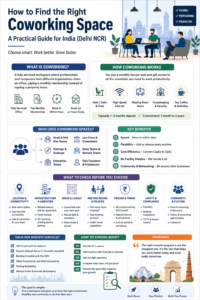
What Is a Coworking Office?
If coworking is the model, a coworking office is the specific product you buy inside it. People use “what is coworking office” and “what is a coworking office” as if they were asking the same question as “what is coworking”, but in practice they are asking something narrower and more useful: what exactly am I renting?
There are six answers, and the difference between them is worth real money.
A hot desk is unassigned seating. You come in, you take whatever is free, you pack up at the end of the day. It is the cheapest option and it suits people who visit two or three days a week. The catch is that you cannot leave a monitor behind, and on busy mornings you may not get the seat you like.
A dedicated desk is a specific desk with your name on it, available whether you show up or not. You can leave a monitor, a drawer of files, and a spare charger. For most people working full time out of a shared floor, this is the sensible choice.
A private cabin is an enclosed, lockable room for one person or a team, inside the shared centre. You still use the common pantry, reception and meeting rooms, but your work happens behind a door. This is what most teams of four to twenty end up taking, and it is the format that has grown fastest in Delhi NCR.
A managed office is a larger private suite, often a full floor or a demarcated block, fitted out to your specification and operated by the workspace provider. Your branding on the wall, your layout, your access control, someone else’s operations team. Enterprises use this heavily. Hub and Oak has been building and running these for over a decade, and it is genuinely a different product from coworking even though the two are sold from the same reception desk.
A virtual office gives you a business address, mail handling and a phone answering service without a physical desk. It is used for company registration, GST registration and credibility, and it is the cheapest thing in the catalogue by a wide margin.
Meeting rooms and day passes are consumption based. You book a boardroom for two hours or a desk for a day, and you pay for what you used.
What comes bundled, and what does not
Almost every coworking office in Delhi NCR will include internet, electricity, air conditioning during business hours, housekeeping, security, a reception, and basic pantry service. Hub and Oak centres include high speed internet, video conferencing setups, meeting rooms, unlimited tea and coffee, pantry, administration support, parking, centrally air conditioned floors, 24×7 security, access control and a recreation zone.
What is usually not included, and where budgets quietly break, is printing beyond a monthly quota, meeting room hours beyond your credits, parking for additional vehicles, after hours air conditioning, event space, dedicated bandwidth above the shared allocation, and anything to do with your own IT hardware. None of these are hidden charges if you ask about them. They become hidden charges when you do not.
What Is a Coworking Office Space? A Walk Through the Floor
The clearest way to answer “what is a coworking office space” is to walk you through one, because the layout is the product.
You come in through reception. In a well run centre this is staffed, not a bell on a counter. The receptionist signs in your visitors, takes your couriers, tells you when your client has arrived, and is the person you complain to when the air conditioning is off. Access is usually controlled by biometric or card entry, and there should be a visitor management log, both for security and because your own clients notice it.
Past reception is the open workspace, rows of dedicated and hot desks. The things to look at here are not the aesthetics. Look at the distance between desks, whether there are privacy screens, whether the chairs adjust properly, and where the natural light falls. A floor where half the desks face a wall in artificial light will feel very different in January than it did in the photographs.
Private cabins run along the perimeter, usually glass fronted with blinds. The single most important question about a cabin is acoustic, not visual. Sit inside one, close the door, and ask a colleague to hold a normal conversation directly outside it.
Meeting rooms and conference rooms are the shared assets everyone competes for. Ask how many rooms exist per hundred seats, how the booking system works, whether credits roll over, and what happens at 11am on a Monday when everyone wants the same room. Ask specifically about video conferencing: whether the room has a proper display, a wide angle camera, a microphone array, and enough dedicated bandwidth to hold a Teams call with fourteen people on it.
Phone booths are single occupancy pods for calls. A centre with a large open floor and no booths is telling you something about how much thought went into the design.
The pantry and cafeteria matter more than they sound. It is where members actually meet each other, and it is the difference between a building full of tenants and a building with a community. Ask about hours, whether tea and coffee are unlimited, and whether there is a fridge and a microwave that people can realistically use at lunchtime.
Breakout and recreation zones give people somewhere to be that is not their desk. Wellness or quiet rooms are becoming standard in larger centres and are genuinely valued by members who need to make a private call, take medication, or simply sit somewhere quiet for fifteen minutes.
Then there is the unglamorous infrastructure that decides your daily experience: washrooms and how often they are cleaned, parking and how many slots come with your plan, printing and scanning, lockers and storage, mail handling, power backup, and event space if you plan to host anything.
Our Okhla centre spans about 25,000 square feet with a capacity of around 350 seats, which is large enough to run all of these as separate zones. Our Defence Colony E-Block centre is roughly 5,000 square feet, which is a completely different kind of building to work in: smaller, quieter, and closer to the courts, which is exactly why a number of advocates work from it. Neither is better. They are different answers to different questions, and that is the actual point of touring more than one space before you decide.
Why Businesses Are Choosing Coworking Spaces in 2026
Something changed in this market, and it was not the freelancers.
For the first decade, flexible workspace in India was a startup product. Small teams, short runways, unpredictable growth. Then large companies started taking floors, and the demand profile inverted. Today a meaningful share of flexible workspace absorption in Delhi NCR comes from enterprises and global capability centres taking managed offices, not from individuals buying single desks. Hub and Oak has run managed offices for a decade, and the enquiries we receive now are overwhelmingly from companies with an existing office elsewhere who want a second location without a second lease.
Four forces are doing the work.
Hybrid schedules broke the fixed floor plate. If sixty percent of your team is in on any given day, a floor built for a hundred people is a floor you are heating, cooling and paying for at forty percent waste. Flexible seat counts fix that arithmetic.
Distributed hiring created a location problem. Companies that hired remotely during and after the pandemic now have eight people in Gurgaon, five in Noida and three in South Delhi. Leasing three offices is absurd. Buying seats in three centres is not.
Capital discipline got serious. A fit-out for a fifty person office in Delhi NCR runs into a substantial capital outlay before you have earned a rupee out of the space, and it depreciates the moment you sign it. Boards that were relaxed about this in 2021 are not relaxed about it now.
Speed became a competitive input. When a client win requires a team in a city within three weeks, a lease is not a viable instrument. This is the single most common reason enterprises call us.
Traditional office, managed office and coworking compared
| Traditional Leased Office | Managed Office | Coworking | |
| Commitment | 3 to 9 years, with lock-in | 1 to 5 years | 1 month to 3 years |
| Upfront capital | High, fit-out plus deposit | Low to moderate | Low, deposit only |
| Security deposit | Typically 6 to 12 months rent | 3 to 6 months | 1 to 3 months |
| Time to occupy | 3 to 6 months | 4 to 12 weeks | 1 to 7 days |
| Furniture and fit-out | Your cost, your project | Built to your spec by operator | Already done |
| Utilities and AMC | Your contracts | Bundled | Bundled |
| Housekeeping and security | You hire and manage | Operator | Operator |
| Reception and admin | Your payroll | Operator | Operator |
| Internet | You provision, 4 to 6 weeks | Operator, dedicated | Operator, shared or dedicated |
| Ability to scale up | Slow, needs new space | Moderate, negotiable | Fast, add seats monthly |
| Ability to scale down | Very difficult | Difficult | Easy at renewal |
| Branding and layout control | Total | High | Limited |
| Privacy | Total | High | Depends on format |
| Community and networking | None | Limited | Built in |
| Cost per seat at 5 people | Very poor | Poor | Best |
| Cost per seat at 25 people | Moderate | Good | Good |
| Cost per seat at 100+ stable | Best | Good | Moderate |
| Exit cost | High, dilapidation and notice | Moderate | Low |
| Accounting treatment | Often capitalised under Ind AS 116 | Depends on structure | Usually operating expense |
| Best suited to | Stable headcount, long horizon | 25 to 200 people wanting control without capex | 1 to 50 people, uncertain growth |
The honest summary is that coworking wins decisively below roughly twenty five people, wins on flexibility and speed at almost any size, and starts to lose on pure cost per seat when you have a hundred people whose number you are confident about for the next five years. If you are in that last category, you probably want a lease or a managed office, and we will tell you that in the first meeting.
How to Find the Best Coworking Space: A Ten Step Process
This is the part people actually search for. I have organised it as a sequence because the order matters. Most bad decisions I see happen because someone started at step three, fell in love with a building, and worked backwards from there to justify it.
Step 1: Write down what you are actually solving for
Before you look at a single listing, describe your situation in two or three sentences. Not your aspiration, your situation.
A solo consultant who needs a professional address and a room to meet clients in twice a month has almost nothing in common with a fourteen person product team that needs to sit together every day and run standups without disturbing the floor. Both will be shown the same photographs by the same directory websites.
Work out which of these you are:
- The solo professional. You need a reliable desk, a good address, and occasional meeting room access. A hot desk or dedicated desk plus meeting credits will cover you.
- The small startup, two to eight people. You want your team within earshot of each other. A small private cabin usually beats scattered dedicated desks, and the price difference is smaller than you expect.
- The growing SME, eight to thirty people. You need a cabin that can grow, and you need to know now what happens when you need six more seats in month five. Ask about adjacent inventory before you sign.
- The agency or studio. Client visits, noise, sometimes odd hours. Meeting room access and acoustics matter far more than the coffee.
- The corporate satellite or sales team. Compliance, invoicing, security and a presentable address usually outrank cost. Your finance team will have opinions about GST and vendor onboarding, so involve them early.
- The distributed team needing multiple locations. Ask whether the operator has more than one centre and whether membership travels between them.
Write this down. Take it to every site visit. It is remarkable how much it protects you from being sold a floor rather than a solution.
Step 2: Build a budget that includes the parts nobody quotes
The advertised number is the desk rate. Your actual monthly cost is the desk rate plus a series of items that are entirely legitimate but rarely appear in the first email.
Start with the base: seats multiplied by the monthly rate. Then add 18% GST, because coworking is a supply of services in India and it is taxed accordingly. A desk quoted at ₹9,000 costs ₹10,620 on the invoice. If your business is GST registered you can generally claim input tax credit on this, which changes the real cost materially, but you need the invoicing set up correctly from day one. Speak to your CA about this rather than assuming.
Then add the variable items:
- Meeting room hours beyond your included credits
- Additional car parking slots
- Printing beyond the monthly quota
- After hours or weekend air conditioning, which some centres charge separately
- Guest passes beyond the free allowance
- One time onboarding, access card or setup charges
- Any charge for a dedicated internet line if you need one
Then the capital items: a security deposit, usually one to three months, and occasionally an advance rental. Ask precisely when the deposit is refunded after exit. Thirty days is normal. Ninety is not unusual. This is a cash flow question, not a trivia question.
Finally, run the comparison correctly. Compare the all-inclusive coworking figure against the true cost of the alternative, which for a leased office means rent plus CAM plus electricity plus internet plus housekeeping plus security plus the amortised fit-out plus the salary of whoever manages it. People consistently compare a coworking quote against bare rent, which is not a comparison at all.
Step 3: Choose location by commute, not by prestige
Everyone chooses location by address. Then they discover that the address costs them ninety minutes a day.
Take your team’s actual home postcodes and map the commute. In Delhi NCR the practical questions are which metro line serves the building, how far the walk is from the station, whether that walk is bearable in June and in January, and whether there is parking for the people who will drive regardless of what the metro map says.
Parking is the item most people underestimate in South Delhi. In several prime commercial pockets, allocated parking is genuinely scarce and street parking is contested. Ask for a number of guaranteed slots in writing rather than an assurance that “parking is available”.
Then look at the surroundings. Is there somewhere to eat lunch? Somewhere to take a client for a coffee? A pharmacy, an ATM, a place to print something at 8pm? Is the approach road well lit and safe for someone leaving at nine in the evening, which is a question I would ask on behalf of every woman on your team even if nobody raises it.
And finally, be honest about whether the address earns its premium. A Connaught Place or Aerocity address genuinely signals something to certain clients. If your clients are in Noida and your team lives in Ghaziabad, it signals nothing except a longer commute.
Step 4: Test the internet yourself, on the day you visit
Do not accept a number. Numbers are free.
On your tour, connect to the guest network, run a speed test, and note the time of day. Then ask four questions. Is the bandwidth dedicated per user or shared across the floor? Is there a second internet service provider as a failover, and does it switch over automatically? What is the power backup arrangement, and does it cover the network equipment and the air conditioning or only the lights and plugs? Has there been an outage in the last quarter, and how long did it last?
If your work involves video calls, ask specifically about upload speed, which is what fails first on a shared connection, and about latency rather than raw throughput. If you run anything that genuinely cannot go down, ask whether the operator can provision a dedicated leased line into your cabin and what that costs.
Then do the thing almost nobody does: visit again at 4pm on a weekday, when the floor is full, and run the test a second time.
Step 5: Compare amenities against your week, not against a list
Every centre publishes an amenities list and they all look the same. The useful exercise is to take your own working week and check it against the list.
If you interview candidates weekly, meeting room availability and reception presentation matter enormously. If you handle physical documents, you need secure storage and a reliable printer, not a shared one on the far side of the floor. If half your team works past eight, you need 24×7 access and after hours air conditioning, and you need to know whether both are included. If you receive courier deliveries daily, mail handling stops being a footnote.
The items worth checking regardless: staffed reception, meeting rooms with working AV, phone booths, a pantry with usable hours, printing and scanning, lockers, guaranteed parking, 24×7 access, biometric or card entry, daily housekeeping, CCTV coverage, power backup that includes the air conditioning, and a maintenance response process that has a name and a number attached to it rather than a vague promise.
One item specific to Delhi that most guides skip entirely: ask about indoor air quality. Between roughly October and January, outdoor AQI in the capital is a genuine workplace issue. Ask whether the building’s HVAC has filtration, whether there are air purifiers on the floor, and how often filters are changed. It is a fair question and a good operator will have a straight answer.
Step 6: Look at who else is in the building
Community is the most oversold and most undersold feature in this industry. Oversold because “networking opportunities” on a brochure means nothing. Undersold because the composition of a building genuinely changes your experience of working in it.
Ask the operator a direct question: what kind of companies are on this floor? Then verify it with your own eyes on the tour. A centre full of law firms feels different from a centre full of early stage technology teams, and both are fine, but you should know which one you are joining.
The useful signals are whether members actually talk to each other in the pantry, whether the operator runs anything beyond a birthday cake, whether there is a members’ group or directory, and whether anyone can name a piece of business that came from a neighbour. Our Defence Colony centres attract a lot of legal and consulting professionals partly because of proximity to the courts, and that clustering produces referrals on its own without anyone organising an event.
Step 7: Visit. Then visit again.
I have never regretted telling someone to tour more than one of our own centres before choosing, and we encourage it openly, because a person who picks the wrong centre leaves in four months and nobody wins.
On the visit, use your senses rather than the brochure. Stand still in the open workspace for two full minutes and listen. Sit in a chair for ten minutes rather than looking at it. Notice whether the light is natural or fluorescent and where you would be sitting. Check the temperature in the far corner, not just near reception. Look at the washrooms, which are the single most reliable indicator of how a building is actually maintained. Look at the ceiling for water stains and the corners for dust. Notice whether the staff greet members by name.
Go at a time when the space is busy. A tour at 11am on a Saturday tells you nothing. And if you can, ask for a trial day. We do not sell day passes at Hub and Oak, but we do arrange trial days through our sales team, and I would encourage you to ask any operator for the same. A day in the space tells you more than four tours.
Step 8: Read the reviews properly
Google reviews for coworking spaces are noisy. Members who leave happy rarely write anything, and a single dispute over a deposit can produce three angry reviews from the same team.
Read for patterns rather than sentiment. Three separate complaints about internet outages across six months is a signal. One furious review about a billing dispute is not. Pay particular attention to reviews that mention exit and refunds, because that is the part of the relationship where operators differ most. And read the management responses, which tell you a lot about how the company behaves when it is embarrassed.
Then go beyond Google. Look at LinkedIn to see who actually works there. Ask the operator for a reference from a current member of similar size to you, and call them. Any operator confident in their service will make that introduction.
Step 9: Understand what you are buying before you compare prices
Membership plans are not standardised across operators, which makes headline prices close to meaningless until you normalise them.
The formats generally run from hourly and daily access, through hot desks and dedicated desks on monthly terms, to private cabins, to enterprise and managed office arrangements on longer terms. What varies underneath is the notice period, the escalation clause, the meeting room credits, the parking allocation, the guest policy and whether the rate is locked for the full term.
Normalise every quote to the same basis before comparing: total monthly cost including GST, for the same number of seats, with the same meeting room hours, the same parking, and the same term length. Do this in a spreadsheet. Quotes that looked twenty percent apart frequently end up within five percent of each other, and occasionally the cheaper headline turns out to be the more expensive contract.
Step 10: Read the agreement, particularly the parts about leaving
The agreement is where the goodwill of the sales process meets reality, and the clauses that matter most are the ones about ending the relationship.
Go through these line by line:
- Lock-in period. How long are you committed, and what happens if you leave early? Is it forfeiture of deposit, payment of the remaining term, or something in between?
- Notice period. Thirty days is common, sixty is not unusual for larger cabins. Diarise the date.
- Security deposit refund. How much, and refunded within how many days of exit? Get the number in writing.
- Does the rate increase annually? By how much? An unspecified escalation clause is a blank cheque.
- What is included. Electricity, air conditioning hours, internet, housekeeping, meeting credits, parking slots, printing quota. Everything not listed is chargeable.
- Upgrade and downgrade rights. Can you add seats at the same rate? Can you release seats mid-term, and on what notice?
- Guest and visitor policy. How many, and is there a charge?
- Access hours. Is 24×7 included or an add-on? Does after hours access include air conditioning?
- Damage, dilapidation and restoration. Particularly relevant for managed offices with custom fit-outs.
- Termination by the operator. On what grounds, and with how much notice?
- Dispute resolution and jurisdiction. Boring until it is not.
If a clause is ambiguous, ask for it to be rewritten rather than accepting a verbal assurance. A good operator will not object. That reaction is itself a useful test.
Six Things Specific to India That Most Guides Leave Out
Almost every article about choosing a coworking space is written for a US or UK reader and then lightly localised. The advice about natural light and ergonomic chairs travels fine. The advice about contracts and compliance does not. Here is what actually differs here.
- GST is 18% and it is not optional. Coworking is treated as a supply of services, so your invoice carries 18% GST on top of the quoted rate. If your business is registered, this is usually recoverable as input tax credit, which is why the effective cost for a registered company is very different from the effective cost for an unregistered freelancer. Get the operator’s GSTIN, confirm your own is on the invoice correctly, and check with your accountant that the place of supply is being treated correctly, particularly if your company is registered in a different state from the centre you are sitting in.
- TDS treatment can get argued about. Some finance teams deduct tax at source on coworking payments treating them as rent, others treat them as a service. The distinction has consequences for both sides and it depends on the substance of the arrangement rather than what the document is called. Ask the operator how their other corporate clients handle it and then take your CA’s view. Sorting this out before the first invoice avoids months of reconciliation.
- Registering your company at a coworking address requires specific paperwork. If you intend to use the workspace as your registered office for company incorporation or GST registration, you will typically need a no objection certificate from the owner, a copy of the rent or membership agreement, and a recent utility bill for the premises. Not every operator provides this, and some charge for it. If registration is part of why you are taking the space, confirm the document set in writing before you pay anything. This is exactly what a virtual office product is designed for, and it is far cheaper than a desk you will not use.
- Building compliance is a real risk in Delhi. Delhi has a long history of enforcement action against commercial activity in premises not zoned or sanctioned for it. If a centre is operating out of a property with questionable land use or without appropriate approvals, the risk lands on you as much as on the operator. Ask about the building’s commercial status and fire safety clearances. Any established operator will answer this without hesitation.
- Power backup is infrastructure, not an amenity. Ask what is on backup. Some buildings back up lights and sockets but not the air conditioning, which in a Delhi May is the same as having no backup. Ask whether the network equipment is on UPS, because a generator that takes forty seconds to start still drops every video call in the building.
- Air quality is a workplace condition here. For roughly three months a year, the outdoor air in Delhi NCR is genuinely poor. Filtration in the HVAC system, purifiers on the floor and a filter replacement schedule are legitimate things to ask about, and the answer varies enormously between operators.
The Pre-Signing Checklist
Print this. Take it on every tour. Tick items as you verify them yourself rather than as they are described to you.
Location and access
- Commute mapped from actual team home locations
- Metro station identified and walking distance measured
- Parking slots confirmed in writing, with number specified
- Visitor parking available
- Approach road lit and safe after dark
- Food options within walking distance
- Cab and auto availability at peak hours checked
Connectivity and power
- Speed test run personally, on a weekday, at a busy hour
- Upload speed checked, not just download
- Bandwidth confirmed as dedicated or shared, in writing
- Backup internet service provider confirmed
- Failover confirmed as automatic
- Power backup confirmed to cover air conditioning
- Network equipment confirmed on UPS
- Outage history for the last quarter requested
Workspace quality
- Sat in the actual chair for at least ten minutes
- Desk dimensions checked against your equipment
- Natural light assessed at your specific seat
- Noise level assessed during a busy period
- Cabin acoustics tested with the door closed
- Temperature checked away from reception
- Air purification and filtration confirmed
- Ceiling and corners inspected for maintenance quality
- Washrooms inspected
Facilities
- Meeting room count per hundred seats established
- Meeting room booking system demonstrated
- Included meeting credits confirmed, and rollover policy checked
- Video conferencing equipment tested, not just seen
- Phone booths available
- Printing quota and overage rate confirmed
- Lockers or secure storage available
- Pantry hours confirmed
- Mail and courier handling process confirmed
- Event space availability and charges checked
Security and operations
- Access control type confirmed, biometric or card
- 24×7 access confirmed as included or priced
- After hours air conditioning confirmed as included or priced
- CCTV coverage of common areas confirmed
- Visitor management process observed
- Housekeeping frequency confirmed
- Named point of contact for maintenance issues obtained
- Staff observed interacting with existing members
Commercial and legal
- Total monthly cost calculated including 18% GST
- Security deposit amount and refund timeline in writing
- Lock-in period confirmed
- Notice period confirmed and diarised
- Annual escalation percentage specified in the agreement
- Upgrade and downgrade terms confirmed
- Guest policy and charges confirmed
- Exit and dilapidation obligations read
- GSTIN of operator obtained
- NOC and address proof documents confirmed if registering your company
- Building commercial status and fire clearance confirmed
- Reference from an existing member of similar size obtained and called
Production note: turn this into a downloadable PDF gated behind an email capture form. It is the single most linkable asset in this article.
Types of Coworking Spaces Compared
| Format | Who it fits | Typical commitment | What you get | Main limitation |
| Hot desk | Two or three days a week, solo | Monthly | Any free seat, common amenities | No fixed seat, cannot leave equipment |
| Dedicated desk | Full time solo or small team | Monthly to annual | Your own desk, storage | Open floor, limited privacy |
| Private cabin | Teams of two to twenty | 3 months to 3 years | Lockable room, shared amenities | Fixed size, shared common areas |
| Managed office | Teams of 25 to 300 | 1 to 5 years | Custom fit-out, your branding, operator runs it | Longer commitment, higher cost |
| Enterprise floor | Large teams needing separation | 3 to 5 years | Dedicated floor and access | Closest to a lease in commitment |
| Virtual office | Registration and address only | Monthly to annual | Address, mail, call handling | No workspace included |
| Day pass | Occasional visitors | Per day | Desk for a day, basic amenities | Not offered by every operator |
| Meeting room booking | Client meetings without membership | Hourly | Room and AV | Booked in advance, subject to availability |
A note on day passes. We do not sell them at Hub and Oak, and I want to be transparent about why: our centres are built around members who work together over months, and heavy transient traffic changes the character of the floor for the people who are actually paying to be there every day. If you specifically need occasional day access, operators like Avanta and WeWork sell day passes and that is a legitimate reason to choose them. If you want a trial before committing to a membership with us, our team will arrange a trial day.
What Coworking Actually Costs in India
Two warnings before the numbers. First, these are indicative market ranges for 2026 gathered from published operator and aggregator pricing, not quotes. Second, every figure below excludes GST. Add 18% to get the invoice amount.
Indicative monthly cost per seat, 2026
| City | Hot desk | Dedicated desk | Private cabin (per seat) |
| Delhi | ₹5,000 to ₹12,000 | ₹8,000 to ₹18,000 | ₹11,000 to ₹30,000 |
| Gurgaon | ₹6,000 to ₹13,000 | ₹9,000 to ₹18,000 | ₹12,000 to ₹32,000 |
| Noida | ₹4,500 to ₹9,000 | ₹6,500 to ₹13,000 | ₹8,000 to ₹20,000 |
| Mumbai | ₹7,000 to ₹15,000 | ₹10,000 to ₹22,000 | ₹14,000 to ₹40,000 |
| Bangalore | ₹6,000 to ₹13,000 | ₹9,000 to ₹18,000 | ₹12,000 to ₹30,000 |
| Pune | ₹4,500 to ₹10,000 | ₹6,500 to ₹14,000 | ₹9,000 to ₹22,000 |
| Hyderabad | ₹4,500 to ₹10,000 | ₹6,500 to ₹14,000 | ₹9,000 to ₹22,000 |
| Chennai | ₹4,000 to ₹9,000 | ₹6,000 to ₹12,000 | ₹8,000 to ₹20,000 |
| Ahmedabad | ₹3,500 to ₹8,000 | ₹5,000 to ₹11,000 | ₹7,000 to ₹16,000 |
Meeting rooms typically run from around ₹500 an hour for a small room in a secondary location to ₹2,500 or more an hour for a large conference room in a prime central address. Day passes, where offered, generally sit between ₹300 and ₹1,500. Virtual office plans usually start in the low thousands per month.
Where the price actually comes from. Location does most of the work. Within Delhi, addresses like Connaught Place, Aerocity and Nehru Place command a clear premium because they signal something to clients, while equally well run centres in South Delhi and Okhla cost meaningfully less for comparable quality. After location, the drivers are building grade, private versus open format, term length, and how much of the amenity load is bundled into the headline rate rather than billed separately.
The arithmetic that matters. Take a ten person team on dedicated desks at ₹9,000. That is ₹90,000, plus ₹16,200 GST, plus perhaps ₹10,000 of meeting room overage, ₹10,000 of parking and ₹5,000 of printing. Call it ₹1.3 lakh a month, with essentially no upfront capital. Against a leased alternative you would be adding rent, CAM, electricity, internet, housekeeping, security, and a fit-out costing several lakh amortised over the term, plus the management time. At ten people the comparison is not close. At a hundred people with a five year horizon, it reverses.
Nine Mistakes I Watch People Make
Choosing on price alone. The cheapest quote in any given micro-market is almost always cheaper for a reason, and the reason is usually bandwidth, maintenance or staffing. You will find out which within six weeks.
Trusting the internet claim. This is the number one cause of members leaving early. Test it yourself, at a busy hour.
Ignoring the commute. A space thirty minutes further away costs your team roughly two hundred hours a year between them. Nobody puts that in the comparison spreadsheet.
Signing a long lock-in for flexibility. The entire point of coworking is optionality. A three year lock-in with no downgrade right is a lease wearing a friendlier logo. If you need a long term, negotiate a lower rate in exchange, but know what you gave up.
Assuming you can grow in place. If you are at eight people and hiring, ask what is adjacent to your cabin and whether it is available. Growing teams that have to move buildings mid-year lose more than they saved.
Skipping the visit. Photographs are lit, shot at wide angle, and taken at 8am before anyone arrives.
Treating parking as a detail. In much of South Delhi it is the constraint, not the amenity.
Reading only the first page of the agreement. The clauses that will affect you are on pages four and five.
Not asking about exit. How long does the deposit take to come back, and under what conditions is it reduced? Ask before you sign, not on your last day.
Who Should Choose Coworking, and Who Should Not
Coworking is the obvious answer for solo professionals, consultants, remote employees whose companies do not have a local office, and early stage teams under roughly ten people. In every one of these cases the alternative is either a home office or a lease, and neither works.
It is a strong answer for growing teams up to about fifty, for agencies and studios who need meeting space and a presentable front, for sales and support teams operating away from headquarters, and for professional practices such as advocates, architects, chartered accountants and designers who need a credible address and a room to meet clients in. Our Defence Colony centres have a noticeable concentration of legal professionals for exactly this reason.
It also works well for enterprises entering a new city, running a project team on a fixed timeline, or setting up a global capability centre before committing to permanent premises. This is where managed offices rather than open coworking usually make sense.
It is a weaker answer if you have more than about a hundred people with a stable headcount and a five year horizon, if your work requires specialised infrastructure such as a laboratory or a manufacturing process, if you handle information under compliance rules that prohibit shared premises, or if brand expression through physical space is central to how you sell. In those cases you want a lease or a purpose built managed office, and there is no shame in saying so.
Questions to Ask Before You Commit
Take these to the site visit. Ask them out loud and write down the answers.
Commercials. What is the all-inclusive monthly rate per seat? What is the GST treatment and can I see a sample invoice? What is the security deposit and when is it refunded after exit? Is there a setup or onboarding charge? What is the annual escalation? Is the rate locked for the full term? Are there discounts for longer commitments or larger teams?
Contract. What is the lock-in? What is the notice period? Can I downgrade mid-term, and on what notice? Can I add seats at the same rate, and is adjacent inventory available? What are the grounds on which you can terminate? What happens to my deposit if I leave early?
Infrastructure. Is bandwidth dedicated or shared? Is there a backup internet provider and does it fail over automatically? What has been the longest outage in the last six months? Does the power backup cover air conditioning? Is the network on UPS? Can I get a dedicated leased line, and at what cost?
Facilities. How many meeting hours are included and do unused credits roll over? What is the meeting room to seat ratio? What does printing cost beyond the quota? How many parking slots are included, and is visitor parking available? Is 24×7 access included? Is after hours air conditioning charged separately? What are the pantry hours?
Operations and compliance. Who is my named point of contact for issues? What is the response time for a maintenance complaint? How often are washrooms cleaned? Are the centres run by in-house staff or outsourced? Will you provide an NOC and address proof for company or GST registration? What is the building’s commercial status and fire clearance position? What is the guest policy and is there a charge?
People and proof. What kind of companies are on this floor? Can you introduce me to a current member of similar size? Can I have a trial day? Can I see the space at 4pm on a weekday? What is your member retention like?
If an operator answers all of these without deflecting, you have learned something important about them regardless of what the answers were.
Why Businesses Choose Hub and Oak
I am obviously not a neutral party in this section, so let me be specific rather than promotional.
Hub and Oak runs coworking and managed workspace across Delhi NCR, with centres in Defence Colony (both C-Block and E-Block), Okhla Phase 2, Jasola, Bhikaji Cama Place and Nehru Place, alongside locations in Gurugram and Noida. That spread exists for a practical reason: a lot of our members have teams living across the NCR, and being able to place people in more than one centre is often the actual requirement.
Our Okhla centre runs to about 25,000 square feet with roughly 350 seats, which supports proper separation of open floor, cabins, meeting rooms and breakout space. Defence Colony E-Block is a smaller 5,000 square foot building with a quieter character, close enough to the courts that a number of advocates work out of it. If you tour both, you will understand immediately why we tell people to see more than one.
Every centre is operated by our own in-house team rather than an outsourced facilities contractor. That is a deliberate choice and it is the reason our members can name the person who fixes things. Amenities across centres include high speed internet, video conferencing enabled meeting rooms, centrally air conditioned floors, 24×7 security, access control, printing and scanning, unlimited tea and coffee, a cafeteria, parking and administrative support.
The company sits inside a wider real estate practice. Alongside coworking, Hub and Oak handles commercial and residential real estate advisory, interior design and project management and fit-out. In practice that means when a member outgrows coworking, we can usually help them lease and build the next office rather than simply losing them. We have delivered managed workspace for organisations including Housing.com, Global Star for Mercedes, Leverage Edu, Unstop, Hunch and Traq Check.
In 2026 we were recognised with the Workspace Brand of the Year award, which we were pleased about, though the metric I actually care about is how many members are still with us two years after they joined.
We do not sell day passes. We do arrange trial days, and we actively encourage prospective members to tour multiple centres before deciding, including our competitors’ centres. A member who chose the wrong building leaves in four months, and that helps nobody.
Ready to look properly? Book a free tour of any Hub and Oak centre, or browse our coworking locations across Delhi NCR. You can also reach the team directly at bookings@hubandoak.com or +91 9711141520.
Frequently Asked Questions : How to Find Coworking Space
What is coworking?
Coworking is a workspace model in which professionals and companies from different organisations share one fully serviced office, paying a monthly membership rather than signing a property lease. The operator handles fit-out, utilities, internet, housekeeping, security and front desk.
What is a coworking space?
A coworking space is the physical premises where this happens: a managed office floor containing open desks, private cabins, meeting rooms, phone booths, a pantry and shared support services, used simultaneously by several unrelated businesses.
What is a coworking office?
A coworking office is the specific unit you rent inside a coworking space. That could be a hot desk, a dedicated desk, a private cabin, a managed office suite or a virtual office address.
What is a coworking office space?
The term is used interchangeably with coworking space. Practically, it refers to the serviced office environment as a whole, including the workspace itself and everything bundled with it: reception, meeting rooms, internet, housekeeping, security and pantry.
How much does a coworking space cost in India?
Indicatively for 2026, hot desks run around ₹4,000 to ₹15,000 a month depending on city and location, dedicated desks around ₹5,000 to ₹22,000, and private cabins from roughly ₹8,000 to ₹40,000 per seat. Add 18% GST to all of these. Prime central addresses sit at the top of each range.
Is coworking cheaper than renting an office?
For teams under about twenty five people, almost always, once you include fit-out, utilities, staffing and management time. For a hundred plus people with a stable headcount and a long horizon, a lease usually wins on cost per seat.
Can I rent a coworking space for one day?
Some operators sell day passes, typically between ₹300 and ₹1,500. Hub and Oak does not sell day passes, but our team arranges trial days for prospective members.
Do coworking spaces have meeting rooms?
Yes, and most memberships include a monthly allocation of meeting room hours, with additional hours charged separately. Check the number of rooms per hundred seats before you sign, because availability matters more than existence.
Is GST charged on coworking?
Yes, at 18%, as a supply of services. GST registered businesses can generally claim input tax credit, so confirm your GSTIN appears correctly on the invoice and take your accountant’s advice on place of supply.
Can I register my company at a coworking address?
Usually yes, provided the operator issues a no objection certificate, a copy of the agreement and a utility bill for the premises. Confirm this in writing before paying, as not every operator provides it. A virtual office plan is the cheaper route if registration is your only requirement.
Are coworking spaces secure?
Established centres run access control, CCTV in common areas, visitor management and 24×7 security staff. For confidential work, ask about lockable cabins, secure storage, network segregation and soundproofing specifically.
Can startups and large companies both use coworking?
Both do. The mix has shifted significantly toward enterprises and mid-sized companies over the last five years, mostly through managed offices rather than open coworking.
Is parking included?
Sometimes, and usually for a limited number of vehicles. In South Delhi in particular, get the number of allocated slots stated in the agreement rather than described verbally.
Can I work 24 hours?
Many centres offer 24×7 access, though it is occasionally an add-on rather than standard, and after hours air conditioning is sometimes billed separately. Ask about both.
How is coworking different from a managed office?
Coworking means sharing a floor with other companies and using common amenities. A managed office is a private, custom fitted suite for one company, operated by the workspace provider. Managed offices carry longer terms and higher cost, and give you control over layout, branding and access.
How is coworking different from a serviced or business centre?
Largely a matter of vintage and emphasis. Business centres traditionally focused on private serviced offices and secretarial support; coworking emerged with more open plan space and community programming. The products have converged substantially.
What documents do I need to join?
Typically company incorporation documents or identity proof for individuals, GSTIN if registered, PAN, and the signed membership agreement. Registration support requires the additional NOC set described above.
Can I upgrade my plan mid-term?
Most operators allow upgrades readily, since they involve you spending more. Downgrades are where the terms differ, so confirm downgrade rights and notice periods in the agreement rather than assuming.
What is a fair security deposit?
One to three months is normal for coworking in Delhi NCR. Anything higher should come with a clear explanation, and the refund timeline should be stated in writing.
How long does it take to move in?
For desks and small cabins, often within a few days of signing. Managed offices with custom fit-out take longer, typically four to twelve weeks depending on scope.
Should I visit more than one space?
Yes. Tour at least three, at a busy hour, and ideally take a trial day at your shortlist. It is the single highest return hour you will spend on this decision.
Before You Sign Anything
The process, condensed: work out what you are actually solving for, build a budget that includes GST and the variable items, choose location by commute rather than prestige, test the internet yourself, match amenities to your real working week, look at who else is in the building, visit more than once at a busy hour, read reviews for patterns, normalise every quote before comparing, and read the exit clauses properly.
Do that and you will avoid nearly every expensive mistake in this market.
One last thought. The best workspace decisions I have seen were made by people who were honest about their own uncertainty. They did not pretend to know their headcount in eighteen months. They bought optionality, kept the commitment short, chose a building they could grow inside, and got on with the actual business.
If you would like to see what that looks like in practice, book a tour at any Hub and Oak centre. Bring the checklist. Ask the difficult questions. We would rather you chose well than chose us.
Srishti Dhir is the founder of Hub and Oak, a Delhi NCR real estate and workspace company operating coworking centres, managed offices and commercial advisory services. She is an alumna of London Business School. Read more about Hub and Oak.